
Criminal Court Cases in Tompkins County
Tompkins County Court is the felony trial court. Its clerk maintains indicted felony files, judgments, sentences, and certificates at the Tompkins County Courthouse, 320 N. Tioga Street in Ithaca. The clerk can be reached at 607-216-6610. Ithaca City Court and the county's town and village courts hear misdemeanors and violations. Those local courts also arraign felony complaints and handle preliminary steps before a felony moves to a grand jury and County Court.
The court that held the arraignment is not always the court that holds the final felony file. The District Attorney's local court contact directory lists Caroline, Cayuga Heights, Danby, Dryden, Enfield, Groton, Ithaca City and Town, Lansing, Newfield, Trumansburg, and Ulysses courts. Start there when a case began outside Ithaca. The sheriff's Civil/Records counter holds police reports, not the clerk's motion papers or final judgment.
Tompkins County Court or City Court
A charge level helps route a Tompkins County court request. County Court alone conducts felony trials in Tompkins County. Ithaca City Court tries misdemeanors and violations and conducts felony arraignments and reasonable-cause hearings. A sustained felony then moves toward grand-jury action and a Tompkins County Court file. A local misdemeanor can remain in City, Town, or Village Court from arraignment through plea or trial and sentence.
This split explains why one name may appear in more than one clerk's system as a case develops. Ask which court has the current docket before ordering a certificate. For Ithaca matters, the Ithaca City Court page provides its clerk channel and criminal jurisdiction. For felony files, use the Tompkins County Court page. Court staff can search a known record more precisely when given a docket or indictment number.
Tompkins County Case Record Searches
Use WebCriminal or its mobile search for public pending case and future appearance information. A known docket is better handled by the originating clerk. OCA's Criminal History Record Search, or CHRS, is a $95 statewide exact-name court search. It is not fingerprint based, not certified, and not a substitute for the full court file.
- Identify whether the case began in Ithaca City Court, another local criminal court, or Tompkins County Court.
- Search WebCriminal by defendant name or case identifier, then filter for Tompkins County and the likely court.
- Compare the date of birth, docket, filed charge, status, and next appearance before treating a result as the right case.
- For an older or missing matter, give the clerk the approximate arrest or offense date, charge, court, and docket if known.
- Request the docket, copies, or a Certificate of Disposition from the clerk that maintains the originating record.
| Field Label | Type | Required | Notes |
|---|---|---|---|
| Search Type | Tab or radio | Yes | Choose defendant name or case identifier where offered. |
| Last Name | Text | Yes for name search | An exact surname is recommended. |
| First and Middle Name | Text | First name directed; middle optional | A middle name can narrow a common-name result. |
| Date of Birth | Date or text | Optional where shown | Use it to distinguish identities; public display may be limited. |
| County and Court | Dropdown or filter | Optional | Select Tompkins and the local court when available. |
| Case or Docket Number | Text | Yes in identifier mode | Use the clerk's exact format. |
| Verification | Challenge | When shown | Complete the anti-automation check. |
Known Ithaca Court Files Cost Less
A broad CHRS search is not always needed for a Tompkins County case. Ithaca City Court says a requester who knows the docket number or an approximate offense or arrest date can ask for public file information. A Certificate of Disposition costs $5. Ordinary copies cost $0.65 per page, with a $1.30 minimum and $40 maximum, while a certified copy costs $6 where applicable.
The County Clerk also staff-searches the felony name index because the public cannot browse it directly. Its criminal-record request form lists $5 per two-year period or fraction for a criminal search, $5 for a disposition certificate, and $0.65 per page for copies. Supply one name per request, the years to search, date of birth, indictment number if known, and contact details. The stated processing time is one to two weeks. Requests can be made in person, by mail, or by email to the County Court clerk.
The Ithaca record-search and certificate instructions are also the source for the successful court image below.
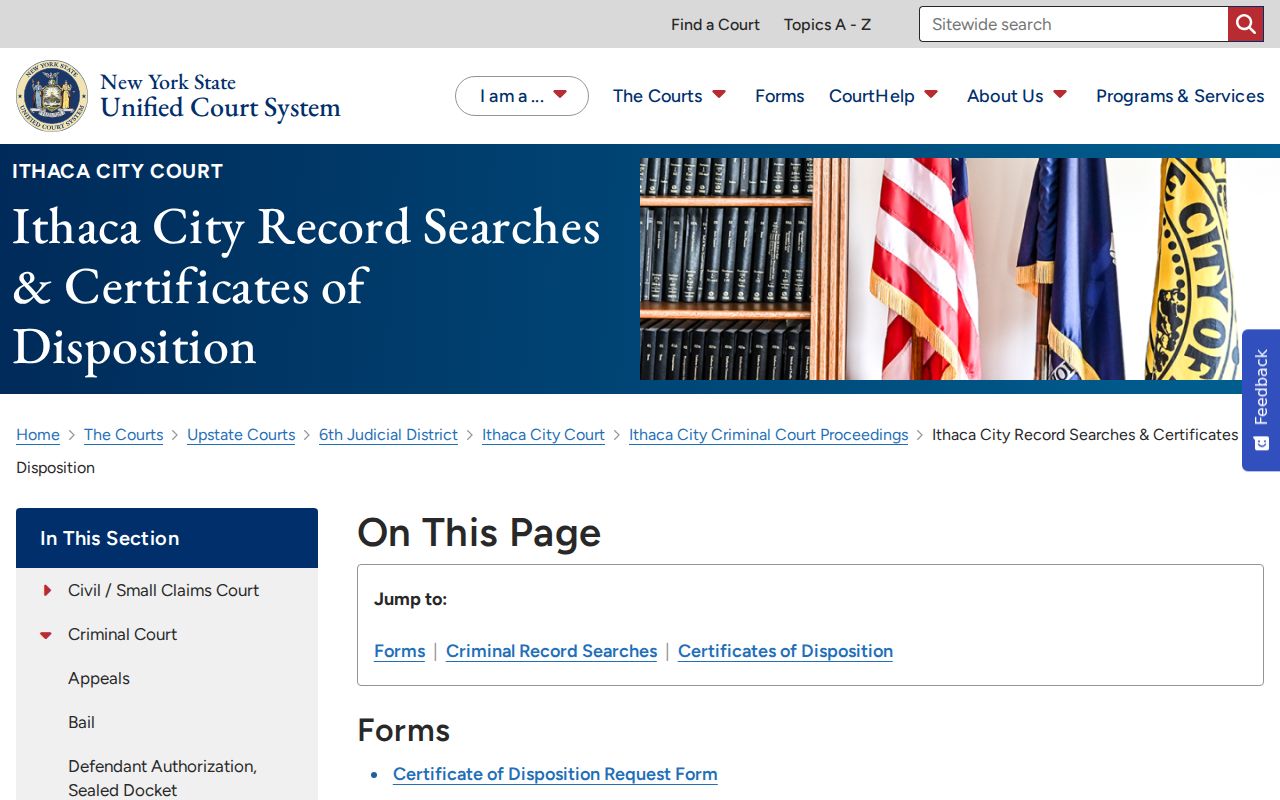
The captured court page reinforces the key split: use OCA for a broad search, but return to the local clerk for a known file or certified outcome.
What a Criminal Case File Contains
A Tompkins County clerk file tells the prosecution story, not just the first arrest allegation. It can identify the filed accusatory instrument, each court event, motions, plea or trial, judgment, sentence, and certificate. WebCriminal may show a useful docket summary, but document images are not always available there. The originating clerk remains the source for a complete public copy or certified disposition.
| Case Number and Court | The docket or indictment identifier and the clerk responsible for the file. |
|---|---|
| Charging Document | The complaint, information, superior-court information, or indictment that states the filed charges. |
| Docket Entries | Appearances, adjournments, motion filings, hearings, and other chronological events. |
| Hearing Dates | Past events and a public next appearance date, time, and purpose when available. |
| Disposition and Judgment | Dismissal, acquittal, plea, or trial outcome and the judgment entered by the court. |
| Sentence and Conditions | Sentence, fine, surcharge, bail, and payment details when they are part of the public file. |
Grand-jury minutes, Social Security numbers, and protected victim or minor details are not public. Sealed cases are also suppressed from public results.
Tompkins County Court Search Gaps
For Tompkins County, WebCriminal is best for pending matters and future appearances. It is not a full rap sheet. CHRS covers public reported cases from all 62 counties, but it uses an exact full name and date of birth. Each alias or added birth date is a separately billed $95 search. Common names can produce false matches, and a no-hit does not prove that no history exists.
CHRS excludes sealed cases, civil and family matters, federal cases, noncriminal violations, and other protected categories. Its historical town and village disposition data is unavailable for May 1991 through 2002 and limited for 2002 through 2007. A case inactive for five years with no reported disposition may be omitted unless an open warrant exists. For these gaps, the local clerk is the sound fallback. A person checking their own fingerprint-supported statewide record should instead use DCJS Record Review.
Note: An online index is a locator; the originating court's certificate is the stronger proof of how a case ended.
Criminal Case Stages in Tompkins County
A Tompkins County criminal file begins with a complaint, information, appearance ticket, or later indictment. At arraignment, the court addresses the charge, counsel, and release or bail. A felony may have a preliminary hearing before grand-jury transfer. A misdemeanor stays on the local track. Discovery and motions follow, then the case ends by dismissal, plea, bench trial, or a six-person misdemeanor jury trial. A sentence and possible appeal come last.
Case flow: Charges Filed › Arraignment › Pretrial › Plea or Trial › Disposition › Sentencing
Ithaca City Court notes that many motions are made within 45 days of arraignment. A felony hearing there tests reasonable cause; it does not turn City Court into the felony trial court. That distinction is visible in the record as the matter moves from a local docket toward Tompkins County Court.
Tompkins County Treatment Court Tracks
Tompkins County Treatment Court is a countywide hub with Judicial Diversion, Felony, Misdemeanor, and DWI tracks. The current program took shape when Ithaca Community Treatment Court combined with the county program in January 2024. Referral and participation documents may therefore appear alongside the standard criminal docket, but the case still remains with its court clerk.
The official Treatment Court page publishes program information and referral forms. A searcher should read the disposition and sentence entries rather than infer an outcome merely from a treatment-court reference. Specialty-court participation describes a case path; it is not itself a separate criminal conviction.
Tompkins County Case Terms
Short Tompkins County docket labels can hide major differences in outcome. These terms help separate a pending event from the final result shown in a Tompkins County court file.
- Arraignment
- The first formal court stage for advice of charges and a plea.
- Accusatory instrument
- The complaint, information, or indictment that starts or supports the criminal matter.
- Disposition
- The recorded outcome of a charge or case, such as dismissal, plea, acquittal, or conviction.
- Adjournment
- A court event moved to another date without ending the case.
- Certificate of Disposition
- The originating court's official statement of the recorded case outcome.
Access Rules for Case Records
Judiciary Law section 255 authorizes court clerks to search and certify records, subject to access limits. Court files are not obtained through county FOIL in the same way as an executive-agency police report. New York's Freedom of Information Law, Public Officers Law Article 6, governs agency records, while judiciary rules and Criminal Procedure Law sealing provisions control court access.
CPL 160.50 generally seals a case after a termination in favor of the accused. A sealed Ithaca City Court matter cannot be acknowledged to an unrelated third party. The defendant may need photo identification, and an authorized third party needs notarized authority. Clean Slate under CPL 160.57 and application-based sealing under CPL 160.59 can also suppress eligible convictions from public access. Youthful-offender, grand-jury, and protected personal information remain restricted.
Missing case? Confirm the court, docket, name spelling, and approximate offense date with the clerk. A sealed record will not be disclosed to an unauthorized requester.
The felony clerk accepts local record requests at 320 N. Tioga Street, P.O. Box 70, Ithaca, NY 14850 or 14851, by phone at 607-216-6610, and by email at TompkinsCountyCourt@nycourts.gov. Check the court's published page before travel because county plans may move some justice offices in the future.